Archive for the 'Tutorials' Category

Watercolor Technique Tutorial

Watercolor8

I am having trouble with my camera but here’s a quick and dirty tutorial on using the watercolor technique to make “torn paper” beads similar to the bead on the lower left.

Watercolor1_edited-1

1. Mix a palette.  I always start a project by mixing a set of colors that “hang together.”  Make at least one color in each hue family and add a mud color to create a palette that you like. You don’t need much clay – 1/2 oz of each color is plenty. 

Option: Add a little bit of aluminum leaf to each of the colors. This adds a slight sparkle similar to mica in stones. I use aluminum leaf because it doesn’t tarnish.

Watercolor2

2. Mix top colors.I like to marbleize three pea sized colors from my palette to make the top colors.  I often include my mud in the mix. This mutes the starting colors so that the final watercolor sheets are more natural - not too  “easter-eggish.”  Run the  clay at the thinnest manageable setting on the pasta machine to make a very thin sheet  that is no bigger than 2″ x 3″.

Option: Do not mix the clay all the way – leave it a little bit mottled. This will add variations of color to the final sheet.  

Watercolor4_edited-1

3. Add black and white.  Sheet white and black at the thickest setting, stack them together, and then place the top color on the white.

There are many variations of this step. The basic idea is to “wash” the very thin top color over a thick sheet of white.  This spreads the color so that it becomes lighter and brighter without actually mixing it with white clay.  The black sheet is added to the bottom for contrast when the sheet is torn.

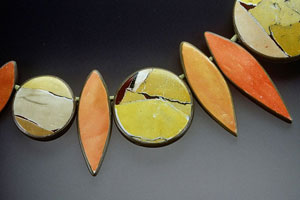
 Option: Use an off-white such as ecru for the white layer, and a deep dark for the black layer. This option is often used by Judith Kuskin to make her beautiful jewelry

Watercolor55. Wash the top color.  Run the stacked sheets though the pasta machine starting with the thickest setting.  Go  progressively thinner until the sheet is very thin (and usually fairly long!) Mix different proportions of your palette colors to make many variations of watercolor sheets.

 Notice how much lighter and brighter the washed color is compared to the original top color.

Option: If your colors are coming out too bright,  add more mud to the top color.

Watercolor6_edited-1 6. Select a color scheme. Looking at all your watercolor sheets, use your instincts to decide which colors to put together. Audition each color with the other colors and adjust proportions until the combination looks good to you.

Before going on to the next step, lay the sheets out next to each other to see where there is lots of value contrast and where there is little. Don’t assume that all the colors will look equally as good against each other.


WatercolorPrep2_edited-1  7. Make mud. Because the sheets go lighter and brighter I usually use a dark color for my background. I keep my scrap clay sorted into three bins – blues and purples, greens and yellows (including oranges which are really just yellows with a little bit of red!) and reds and magentas. This makes it easier for me to mix clearer colors when I don’t want mud. When I do want mud,  I pull a little bit from each pile taking more from the blues/purples if I want a gray mud, more from the green/yellows if I want an ocher mud, and more from the reds/magentas if I want a brown mud.

WatercolorPrep8. Make base beads from mud. To make base beads, mix some mud from scraps until it is all one color.  Roll it into a ball while pressing all the air out. Roll the ball into a log and cut off chucks to make  smaller balls.

Option: If you want all your beads to be similar in size, measure and cut the same amounts off the log.

Watercolor7_edited-29. Collage torn sheets.  Tear off small pieces of the watercolor sheets and collage them onto the bead blanks. I like to leave some of the dark background color showing for contrast. Gently roll the collaged sheets into the base bead and then form the bead into a shape you like. Pierce the beads before baking if you don’t want to drill holes after baking.  Bake according to the clay brand instructions.

Option: Roll the beads with some cornstarch to make them smooth. Bake the beads on a bed of cornstarch to prevent flat spots.

Note: The beads and pendents at the top of this post are all older variations of the watercolor technique. The pivot beads from Chapter 2 are a new variation that uses a black, white and gray striped cane as the white layer.  Play with making watercolor sheets using:

  • A stretched out cane slice for the top color.
  • Crumbly old white clay for the middle layer.
  • A Skinner blend for the top color.
  • A textured white piece for the middle layer.
  • Mokume gane for the top layer.
  • A dark color for the middle layer.

The possibilities are endless!

Exercise #3 Pivot Tiles

829SatWhiteNeutralBlack

The concept of saturation is a tough one. The terms tinting and shading usually have to do with changing the value of a color but they also have to do with changing the saturation. Tinting is mixing a color with white, shading is mixing a color with black (or mud, or the complement.) The term “tone” is used when a color has both white and black in it. In strict color theory books – a tone is a grayed out version of the original color that still has the same value of the original color.

Instead of the standard terms “tint, shade and tone” we chose to sort colors into saturation families. Colors are either rainbow pastels, earths or earth pastels depending on how much the pure color is mixed with white, with black/mud, and with both white and mud together.

As soon as you start mixing a color with black/mud, or white, you are changing the saturation as well as the value and the hue. It doesn’t matter if you call the shifted colors muted or desaturated,  tints or rainbow pastels, tones or earth pastels,  shades or earths, the fact is that the new colors are no longer 100 % pure. 830PastelHueFamiles2

Pastel Color Sorter. All the colors on the pastel color sorter have  been desaturated with just white, or white and mud together. Notice that they have a very different feel from the colors on the Classic Color Sorter which have no white in them at all.

Saturation Zones or Families

faberbirrentinttoneshadeOur illustration for saturation families is based on Faber Birren’s “Tint, Tone and Shade” drawing. This classic diagram appears in many books on color. It shows a color modified by adding white to get tints, gray to get tones and black to get shades.

The pivot tiles you are making are designed to show all these variations of colors. The more variations you make the better you will understand the subtle differences that are available to you when you start putting colors together.

Weekend Extra Exercises

1. Any color can be pivoted. Try making pivot tiles with colors that are not pure package colors. Mix up a beautiful earth color and then make a warmer and cooler version of that color.  Tint each of the three variations with white, tone them with grey and shade them with black.

2. Make at least one tile using variations of white and black. For example, use Premo Ecru as a white,  Burnt Umber as a black, and a 1:1 mix of Ecru and Burnt Umber as the “gray”.

3.  Intentionally mix a dark mud to use instead of a black. There are many ways to make dark muds – try mixing a cool blue with a brown (Ultramarine Blue and Burnt Umber.)

4. Later on in the book, once you have mixed colors to go with your collage, make more pivot tiles to go with “your” colors.

TIPS

jeanette sclar's pivot tileUse a Sharpie to label the back of your pivot tiles with the names and proportions of the warming and cooling colors you chose and with the black and white you used.

Jeanette Sclar sent in this photo showing her variation on pivot tiles. She keeps track of the colors added and the proportions used by adding stripes to the top and side of each of the sections. In this sample she used Cobalt and Zinc Yellow Premo to pivot Cadmium Red.  The proportions on the left are:  half blue/half red and 1/4 of another square of either white, gray or black. She wrote: “ This is the perfect illustration of your statement  that cad red with any blue results in muddy purples!”

jeanettekandraykatopivots

Keep track of which black and white you are using.

Jeanette Kandray is doing a new blog just on the exercises from the book. She emailed me about the difference in the strength of the Kato clay vs the Premo blacks: “I started out working with Kato and learned that adding the black made an intense change in the color properties.  I switched to Premo and there is a big jeanettekandraypremopivotsdifference.  Now I know that I have to go very easy on the black with Kato but not so with the Premo.”

If you look at the comparison chart on page 33 , you will see the differences in the strengths of the black and white package colors for the various brands of clay.  The black and white of the Polyform clays are fairly balanced in strength  – a half and half mix (1:1)makes a middle gray. The black of Fimo Classic is a little bit stronger than the white – it takes 6 parts of white to 2 parts of black  (3:1) to make a middle value gray. The black of Fimo Soft and Kato clay is lots stronger than the white – it takes 7 parts of white to 1 part (7:1) of black to make a middle gray. That is a big difference!

FAQ’s

1. Why doesn’t your saturation diagram use the terms “tints, tones and shades?”

Our diagram was designed to show large saturation shifts – from pure to earth color for example. These large shifts put colors into groupings that have a similar feel. We think the names we chose reflect these different feelings. Tinting, toning and shading are smaller shifts that can be done to any color, regardless of the saturation family. Picture a terra cotta (an orange with both mud and white = an earth pastel ). It can be tinted, toned, and shaded the same way a pure orange can be tinted, toned and shaded to make many variations of the same color.

2. I added green to my yellow in the proportion you show (4:1) and it turned the yellow a bright green. Can I change the proportions?

Absolutely. The idea is to get slight variations – not change the color entirely. Yellows are wimps. Instead of adding 1/4 of a cool color to the yellow, you may want to add less because your green is a bully.  Just be sure to label the tiles, expecially if they vary from the directions in the book.

Jill Kollman leftovers from pivot tiles3. What to do with all the little bits leftover after making your pivot tiles?

They can be used for the Pivot Bead project or  Jill Kollmann sent me this wonderful photo and said, “ I had so much fun making my pivot tiles!  And all these wonderful swatches of clay left over.  So I made these additional “reminder” charts to reinforce the mixes in my mind.  Each of the mixed colors is in a square, and underneath each mix are dots of the 2 or 3 colors I used to make each mix.  It’s not proportional – I drew a square at the bottom so I would remember how I “got there”.  It’s raw, and covered in plastic.  So this will also help me to remember which colors shifted during baking.  Eventually I’ll “just know”, but for now this is going to help reinforce the learning.  I love color school! ”

Exercise#1: Testing Package Colors

 1finalclassic sorter


A New Color Diagram

After playing with many versions of triangular and circular color diagrams,  I decided to design a hybrid Color Sorter specifically for the book. I called the primaries Yellow, Blue and Magenta and divided them each into two variations.  

I have argued for years that Cyan should replace Blue as a primary, but I did not include the color Cyan on the new sorter for two reasons: #1. During my many years of teaching color workshops, I found that hardly anyone – even the most computer savvy students – could accurately pick out Cyan from a pile of swatches, and #2. Since all full saturation blues will mix with a magenta color to get clear purples and the same blues will mix with yellows to make greens, its just not that important to find the perfect blue primary.  (Sacrilege, I know!)

On the other hand, unlike blues, your choice of  a “red” primary is critical when mixing colors. I wanted to show that Magenta colors – like Fuchsia and Cherry Red - are primaries and that orange reds (we named them Tomato Reds) –  like Scarlets and Cadmium Reds – are secondaries that come from mixing Magentas and Yellows.  If you use a tomato red you will never get a clear purple no matter which blue you use.  

If you have ever taken a workshop with me, you know how much I love mud colors.  I think its important to understand that mud colors can be sorted depending on which of the primary color families they come from.  Ochres come from colors with lots of yellow in them, grays from colors with lots of blue, and browns have a high proportion of magenta.

Weekend Extra Exercises

1.  Look at the sorter on page 138 and sort all your “reds” into either the Tomato Red or the Magenta section.  Mix a  ”tomato red” clay half and half with a blue clay and then mix a “magenta” clay half and half with the same color of blue clay and see what you get.

2. One of the reasons to do test mixing with white is to see the “bias” of the package color. Pick one of the hue families that you have many different variations of package colors and make test mixes of each one. Take some time to compare the tinted version with the out-of-the-package colors.

3. Make an enlarged copy of each of the Color Sorters on page 133 and 134 and laminate them.  As you are making your package color test samples, sort the clay into one of the  color sorter sections. Most of the package colors will usually fall on the Classic Sorter and the tinted versions will usually fall on the Pastel Sorter. (Studio by Sculpey colors are the exception. Many of their package colors are pastels.) If you are not sure about a color just put it between the sections that seem closest to the color.  

4. As you are sorting your samples, note your instinctive reactions to the color names that Lindly and I gave to each section. Do you agree or disagree with our choices? Everyone has different reactions to color names. Feel free to rename the sections whatever pops into your head.  I am very curious about what names you would change -  especially if you have a strong negative reaction to our names – and encourage you to send in your preferred names in the comment section.

TIPS

P1000287_edited-1Label an index card with all the package colors you plan to test before you start mixing and then bake the finished samples on the card.

If you want to put magnets on your samples, sheet the clay at the middle setting instead of the thickest setting so that the test mixes will weigh less.

Sheet a large sheet of white if you plan to make lots of test mixes.

Put your package colors into three piles as you finish each test mix with white. Make one pile the “Wimps” for the colors that turned very pastel. Make another pile the “Bullies” for colors that did not shift very much when mixed with the white. In between put all the other colors. Remember which are the wimps and which are the bullies when you mix colors from now on!

FAQ’s

1. Why do we use cutters?  Using the cutters on sheets of clay run at the same thickness in the pasta machine is as close as you can get to mixing  exactly equal parts.

2. What should I do if I don’t have a 3/4″ square cutter?  You can make your test samples with any cutters you have on hand –  just make the out-of -the-package sample piece large enough to hold the tinted version of the package color mixed half to half with white. Experiment with your cutters to see what sizes work best for you.

3. Can I use any brand of white clay? No. Since some of the clays now have very different baking temperatures, be sure to only use a white clay with a baking temperature that is the same as the clay you are testing.

4. What did you use to stamp the initials of the brand of clay into the test mix samples?  I made ”chops”.  I incised the initials into a sheet of raw clay, baked it and then used it as a plate to make the reverse initials.  I cut out the reverse initials after baking and glued them to the end of pieces of scrap clay.

P1000283_edited-1

There’s quite a bit to absorb in the first few chapters.  Just have fun playing with the exercises and don’t worry about doing them “right.”   No matter how much you know about color, picking up the clay and doing some test mixes will teach you something new!

Handouts for Video 3

tri.jpgJoey and I spent some time tonight posting the third video, Smashing Color Triangles. Then I remembered I need to give you the links for the handouts. Here they are:

The video ends with a suggestion to use the triangle to practice mixing colors instinctively – without using just three primaries or depending on formulas.

Yes, three primary mixing is a good way to learn where colors live, but you don’t have to be limited to only “red”, “yellow” and a “blue.”

I labeled the Instinctive Triangle with some Premo package colors. Play with shifting some of these different package colors by thinking of the triangle as a mixing map.

Pinpoint the color you are starting with on the map and then imagine the position of the new color you will try to make. Draw an imaginary line (usually slightly curved down) through the two colors. This line will show you what direction to go with the color.

Find a color further along the line to mix with the color you want to move. You may have to play with proportions, but somewhere along the line you will hit the color you are looking for. The color names on my version of the triangle may not be the same names you would use.

Once you see the way the colors flow from the different purples to yellow, you may want to come up with your own names for the colors that fall along each of these paths.