Monthly Archive for October, 2009

Using the Tasting Tiles

tasting tiles 3The rally was lots of fun. Pioneer Courthouse Square was filled to the brim with people carrying 350 banners. I love my city!

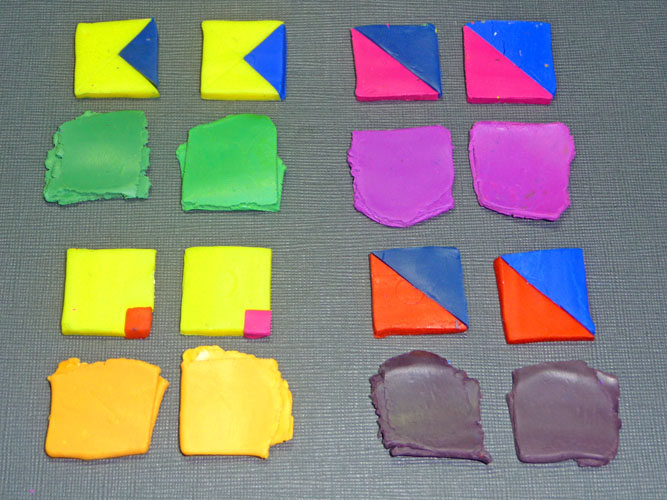
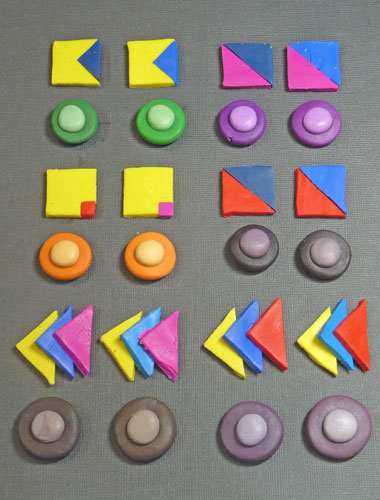
Here are my Kato tasting tiles, including four muds made with equal parts of the various three primaries. The set-up for the muds is different from the book. I cut the squares of each primary color in half diagonally.

Note that even though I am taking these photos under full spectrum lights, they are not totally accurate. The blues are especially hard to capture.


Analyzing the Tiles 

I can tell just by looking at my collage that I probably won’t be using Magenta. It doesn’t appear in my collage and doesn’t make the secondary mixes I need.

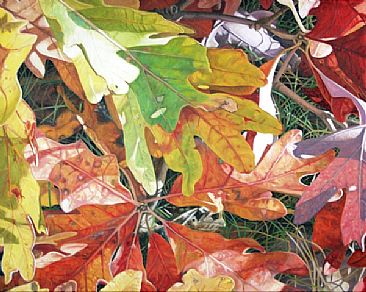
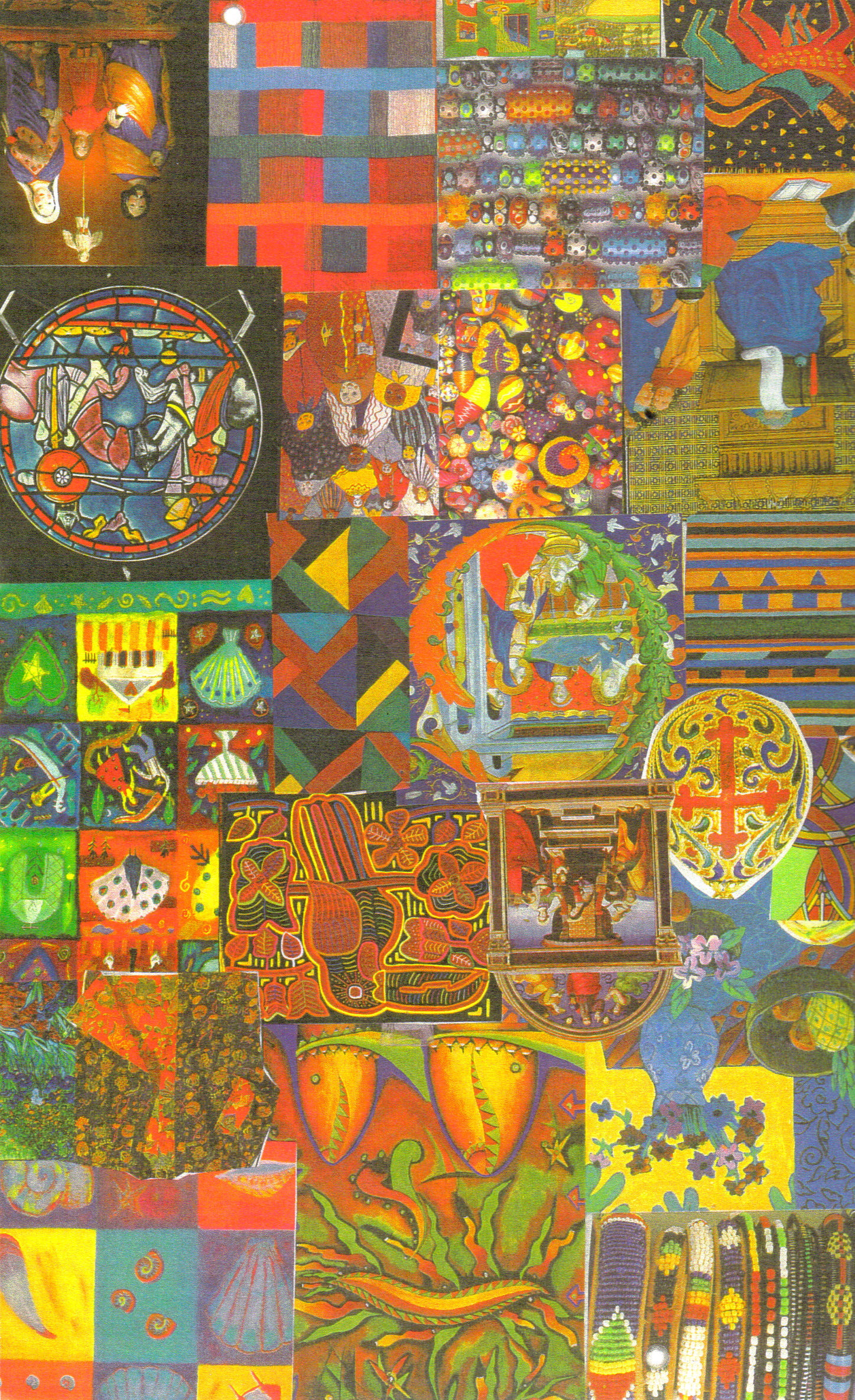
Just for fun, I cut up a copy of my collage that appears in the book.  I was curious to see how much of each primary and secondary hue there would be. It turns out tasting tiles4that in my collage there are some slightly muted greens, a larger section of blues, lots of red orange and oranges, and a very large section of yellows with a good amount of ochres. There are no clear purples.  Instead of purples, there are many dark eggplant browns that match the Kato purples made with Kato Red.


Choosing Primaries

tasting tiles5If I was going to use Kato clay to match colors to my collage, I could rule out using Magenta very quickly.   The Red will give me the oranges and the eggplant purples that I need so its the better choice.  Since there is only one yellow, the big question is – which blue should I use? I would choose Kato Blue instead of the Turquoise because the greens I want are a little bit muddy.  I also like the dark brown mud that results from using the Blue. The tasting tiles helped me confirm that the Kato primaries for this collage are the traditional Red, Yellow, and Blue.  The colors I mix with these three primaries will give me a palette that matches my collage.

Weekend Extra Exercises

1.  Make a color copy of your collage and cut it up into color swatches. Don’t be too picky – stick to just the six hue families and one or two mud colors.

2. Sort the swatches into hue families and glue them onto a piece of 11″ x 17″ poster board. Because you will lose some of the collage as you cut and because you’ll end up overlapping some of the piece, you will probably only cover about 3/4 of the board.

3. Look at all the variations in each of the hue families. How much hue, value and saturation range is there?

TIPS

If you use more than one brand of clay, be sure to mark your tasting tiles with the brand.

If your white clay is crumbly out of the package, cut a slice of white that is the same thickness as your tasting tiles. Then you don’t have to make a snake. Just use the circle cutter to cut pieces from the slice to mix with the pieces cut from the center of the tasting tile.

Look at both the untinted and tinted parts of the tasting tiles to determine which primaries make the colors that match your collage.

When I was cutting up my collage I used small envelopes for each of the hue families. This kept all the little pieces from flying away or getting lost on the table in my studio. (Easy to do given the mess!)

FAQs

1. Why limit the clays to just three primaries?

We suggest starting this way so that you can learn how to mix colors using the fewest package colors. Sometimes you need more than three to get the colors you need and sometimes its just easier to start with a package color for each of the six hue families. That’s OK.

2. Can I use black if its in my collage?

I like to use a mixed black instead of a package black but if you have lots of pure black in your collage then you can use package black.

3. What should I do if I can’t decide between two primaries?

You can mix the two primaries together or you can choose to use both for your palette. There are no fixed rules. The goal is to be able to mix colors to match your collage.  A little exploration goes a long way toward making color mixing much easier.

Kato Clay Tasting Tiles

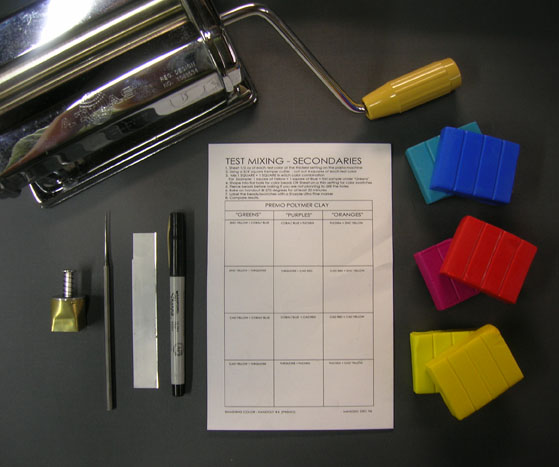
tasting tiles2 Here is the first step in making the tasting tiles using Kato Clay.  I used Yellow, Blue, Turquoise, Magenta and Red.

Greens:  The first mixture of Yellow with Blue came out slightly muted. That is due to the Blue clay’s bias toward magenta. The Yellow with Turquoise  came out very clear.

Oranges: The mixtures of the Yellow/Magenta and the Yellow/Red both came out clear. That’s because there is no blue bias in either the Magenta or the Red.  You will often hear that magenta is a red with a blue bias. That is not true. Magenta is a true primary. Red is actually a magenta with yellow in it.

Purples:  The first mix is with Kato Blue. Kato Blue has a magenta bias, so it mixes with Magenta to make a clear purple. Kato Turquoise clay is a true primary blue. It doesn’t have much of a bias to either yellow or to magneta so when it is mixed with the Magenta , the Turquoise also makes a clear purple. But look at the mixtures with Kato Red! They are both brown instead of purple. That’s due to the yellow in the Red clay.  Remember that yellow is the third primary.  It combines with the other two primaries to make mud. If you need a clear purple in Kato clay, be sure to use Magenta as your primary, or buy the package Purple.

Today is the International Day of Climate Action and I am off to the rally in downtown Portland.  When I get back I will use the Kato Tasting Tiles that are now in the oven to show you how to find the best primaries for mixing the colors in your collage.

Studio Tool #1:Tasting Tiles

materials-for-test-mixing_edited-1.jpg

This is the first of two Studio Tool exercises in the book.  We originally had more of them, including a fan deck of Skinner blends, but due to space limitations we had to cut them out. I will try to add instructions for the missing tools at the point in the book where we wanted them to be.

The Tasting Tiles are designed to be part of a reference set of color samples that you keep on hand to check when you are deciding which clays to use to make a palette.

A few years ago I posted instructions and a form for test mixing secondaries that was based on mixing all the secondaries using equal parts of the primaries. (Download PDF Test Mixing Handout (for Premo and Kato) or (for Fimo)

For the book, Lindly and I decided to use different formulas for each the secondary colors:

Violets: 1/2 blue:1/2 magenta

Greens: 3/4  yellow: 1/4 blue

Oranges: 15/16 yellow: 1/16 magenta

Muds: 1/3 yellow, 1/3 blue. 1/3 magenta

NOTE: The diagram of GREEN on the bottom page 56 is incorrect. It should show 1 part blue:3 parts yellow. (I am much more understanding of mistakes in books now that we have published ours!)

Tasting Tiles are all about undertanding hue bias, and hue bias is all about MUD. Here’s an excerpt from the same post from a few years ago about test mixing and mud:

painters-wheel.bmp

cmy-with-lables.bmp 


Traditional theory says R+Y+B =Black, and Modern Theory says C+M+Y=Black.  Reality is Three Primaries = MUD. I define MUD as the color you get when you mix primaries in equal amounts. Depending on which primaries you pick MUD can be many colors.

Traditional MUD 

If you have been mixing colors using the traditional Red, Yellow, Blue primaries then you are familiar with the reality that MUD is in the middle. MUD in the RYB system is usually closer to a brown than a gray.

Modern MUD cmyenvelope1_edited-1.jpg

This diagram of the CMY color space shows that the mixture of C+M+Y is somewhere between black and white. MUD in the CMY system is more gray than brown.  Note that this diagram is misleading because it shows the primaries all at a middle value and we know that’s not true!


 Understanding Primaries Undertone/Bias

There are no perfect primaries. Each of the colors we think of as a primary leans a little (or a lot) toward one of the other primaries. This is called the color’s bias. See page 25.

When you try to mix a secondary color from two primaries you need to know how far away your primaries are from the imaginary perfect primaries. For example, Ultramarine Blue is really Cyan, or primary blue, with quite a bit of Magenta. Golden Yellow is Yellow with just a titch of Magenta.

If you mix Ultramarine Blue with Golden Yellow expecting a bright green you will be disappointed. The magenta in Ultramarine and the magenta in Cad Yellow will get together and steal an equal amount of primary blue from the Ultramarine and also grab some yellow from the Cad Yellow.

The combined B+M+Y will make a MUD that is close to gray. That gray will mix with the green to make a gray green instead of a bright green.

To successfully mix colors, the first thing you need to know is how much Blue, Magenta and Yellow are in each of the colors. One way to find this out is by mixing tasting tiles.

Time to start mixing colors! Be sure to label as you go . . .”

Weekend Extras Exercises

1. Make the tasting tiles in clays other than Premo.

2. Try using orange reds, such as Premo Cadmium Red, Fimo Soft Indian Red, or Sculpey Tomato Red instead of magenta/fuchsia/cherry red versions of the primaries.

3. Change the formulas for the secondaries based on the results you get using our consensual formulas.

4. Make a set of tasting tiles using mixed primary colors instead of primaries out of the package.

5. Customize/mix your primary colors so that you get the secondaries you like the best.

6. If you haven’t watched Beau Lotto’s  TED video that Cynthia posted on Polymer Clay Daily yesterday – watch it! Its very fun and shows lots of what will be covered when we get to the chapter on “Playing Games with Color.”

TIPS

labeling-test-mixes.jpg

You can choose any primary from the chart on p. 138  to mix tasting tiles.

Make a chart similar to the one shown at the top of the post and label each square with the clays and formulas you are using to make the tasting tiles. Bake the samples on the chart so that you can keep track of what you are doing. 

If you don’t want to make the pie chart labels you can label the tasting tiles using a Sharpie.

When tinting the center of the tasting tiles with white, try to keep the mix close to 1/2 color/1/2 white.


FAQs

1.  Why are some reds in the primary section of the chart on p.138 and some reds in the secondary section? 

There is so much yellow in Orange Reds that they cannot be used to mix clear violets. If you don’t mind muddy violets feel free to use orange reds as primaries.

2. Tasting tiles are a lot of work – why bother? 

In the process of making them you will learn a huge amount about how colors mix, plus you will have the tiles on hand for future reference. Just do it!

 Which colors have the most MUD? Which the least? Can you figure out why?

Tracking Peak Color

peak-color.jpg

 I live in the Pacific Northwest.  We don’t have the same kind of fall leaf season that I grew up with in the Northeast.  I remember as a kid coming up over a hill and seeing a panoramic view of mountains lush with color. The colors were so bright I remember thinking, “The leaves are all the colors of Fruit Loops!”

In Oregon, our mountains are evergreen - with just occasional spots of autumn color. We don’t talk about the leaves the way someone on the east coast talks about the leaves.  I don’t ever hear the words “peak color.” Thankfully our neighborhoods  put on a quite a show – at least until the rain knocks all the leaves into the streets.

I’ve been traveling on the East Coast for the last two weeks and wondering when I would see some gorgeous fall color. It finally happened as we drove through the mountains of western Pennsylvania. It was stunning! Just like I remembered.

My anticipation of finding peak color led me to a few fabulous websites for tracking fall foilage.  The Foliage Report has leaf maps for the Northeast, Southeast and regions. The WeatherBug site has a leaf tracker map and an article on the science behind peak color.  Its interesting to know that orange, yellow and brown leaves come from the pigment carotenoid and red and purple leaves come from pigment anthocyanin but I prefer not to think of the science of it all and just be awed by the amazing beauty of our world.