Monthly Archive for October, 2007

Handouts for Video 3

tri.jpgJoey and I spent some time tonight posting the third video, Smashing Color Triangles. Then I remembered I need to give you the links for the handouts. Here they are:

The video ends with a suggestion to use the triangle to practice mixing colors instinctively – without using just three primaries or depending on formulas.

Yes, three primary mixing is a good way to learn where colors live, but you don’t have to be limited to only “red”, “yellow” and a “blue.”

I labeled the Instinctive Triangle with some Premo package colors. Play with shifting some of these different package colors by thinking of the triangle as a mixing map.

Pinpoint the color you are starting with on the map and then imagine the position of the new color you will try to make. Draw an imaginary line (usually slightly curved down) through the two colors. This line will show you what direction to go with the color.

Find a color further along the line to mix with the color you want to move. You may have to play with proportions, but somewhere along the line you will hit the color you are looking for. The color names on my version of the triangle may not be the same names you would use.

Once you see the way the colors flow from the different purples to yellow, you may want to come up with your own names for the colors that fall along each of these paths.

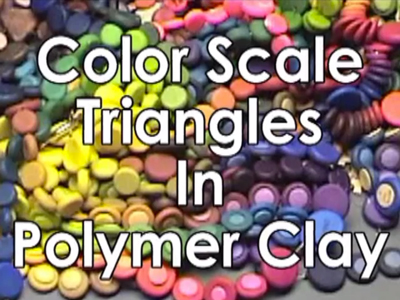
Color Scales Triangle Video

Over the years I’ve tried many different ways to mix the colors in the middle of a three primary triangle. Nothing seemed to work until I came up with what I call “Base Mixing.”

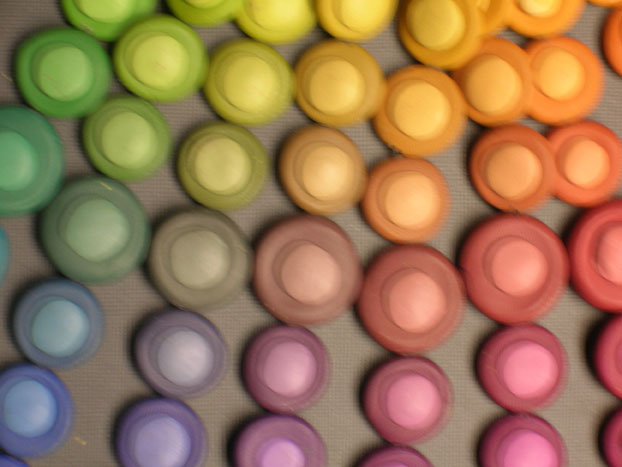
Base Mixing is a two part process that starts with mixing a series of purple colors along the bottom of the triangle, running from a primary “blue/cyan”  to a primary “red/magenta.” The second step is then to mix scales with each of the base colors to a primary lemon or zinc yellow.

I have found that no matter what medium I use – polymer, paint, crayons, pencils or dye – the resulting color scales always follow the same color flow.

For example, when you start with a Blue Violet base color (think of that beautiful, rich color that some people call blue and some call purple) you will always run through a gray, a gray green and an olive green on your way to yellow.

The gray will show up at different levels of the triangle depending on the tinting strength of your Yellow in comparison with the Blue Violet but some version of gray will fall along this line.

Exploring the way color flows from the various purple base colors to yellow will help you learn how to mix and shift colors without using formulas.

Try it in polymer or in any medium that you use!

Colors of Majolica

della-robbia-in-dc-1475.jpgThe Majolica style of painted ceramics was introduced to Italy in the 14th century from Moorish Spain by way of the island of Majorca. Think spanish tiles and you will probably have some idea of what inspired the Italian majolica artists.

In the middle of the fifteenth century, Luca della Robbia (1400-1482) developed the blue and white glazes that were used on the early terra cotta sculptures that came to be known simply as della Robbias. (Luca’s nephew, Andrea, and Andrea’s sons, Giovanni and Girolamo, continued the della Robbia tradition in the family’s studio in Florence.)

della-robbia-andrea21475.jpgWhen I picture a della Robbia I imagine a wall piece designed as a circular weath with fruit and flowers surrounding a bas relief figure.

della-robbia-giovannipieta1510.jpgIn my research, I was surprised to find that the della Robbias also made freestanding sculptural figures.

This is a Pieta by Giovanni della Robbia from 1510.

The rich colors came from stains and natural oxides applied over the white tin glazed earthenware. The painting was then covered with a clear layer of glaze and fired again to protect the colors.

By the late fifteenth century majolica colors included the white tin glaze and five natural materials used as paints: cobalt blue, antimony yellow, iron red, copper green and manganese purple.

della-robbia-francesco-da-rovigo-1520.jpgIn the sixteenth century other colors were added including luster colors such as ruby red, pink, yellow and a reddish brown as you can see in this gorgeous plate by Francesco da Rovigo.

keiner1.jpg

Contemporary artists are still exploring majolica. One of my favorites is Portland artist Connie Kiener.

I was introduced to Connie’s work over twelve years ago when I saw the stunning 3′x3′ panel of lush flowers that she painted on tiles for a client’s kitchen remodel.

Around that same time her work was featured in the November 1994 issue of American Craft. The article included many images of her intricately detailed paintings on large circular plates that I remember to this day.

(I just wish I could find that issue. It is probably in one of the stacks of magazines that I duct-taped together to use under the legs of my studio table to raise it to standing height.)

majolica-connie.jpgConnie’s work has changed considerably since 1994 though she continues to push the art of majolica.Her recent pieces are much more three-dimensional and figural. Much like some of the early della Robbias.

Connie is represented in Portland by Laura Russo Gallery.

______________

The National Polymer Clay Guild Synergy Conference will be held in Baltimore during the same week as the American Craft Show. The conference dates are Feb 21 – 23, 2008.

Today is the first day you can register for the conference. If you register during the month of October you will be guaranteed your first choices of seminars and can add two free seminars to the six that come with the registration fee of $245 (for NPCG members.)

The Synergy Team worked hard to make this event as affordable as possible. Rooms in the conference hotel are $109 plus tax for two people and you can squeeze in a couple more for only $20 each a night. The rooms all have fully equipped kitchenettes so you can choose to bring your own food if you want to save even more.

If you are within driving distance of Baltimore, you can carpool with some friends and share transportation costs. If you are planning to fly check out Cheat Nuetral for a fun perspective on the issue of carbon offsets.

Hope to see you in Baltimore!