Academic Regalia

Its that time of year again. The strains of Pomp and Circumstance fill the air as commencement ceremonies all over the country open with the faculty filing into the field, or gymnasium, or stadium, or convention center.

Tradition calls for the faculty and students to be dressed in academic regalia. Academic regalia, or academicals, refer to the cap, gown/robe, and hood worn during graduation. The rules are not hard and fast but faculty with doctorates usually wear robes with three stripes, hoods and velvet tams instead of mortorboards. Faculty with masters degrees wear a simpler gown with a wide hood. Graduating students wear a cap and gown with a hood indicating their degree.

If you are heading off to a graduation this year, here’s a handy chart based on the Intercollegiate Code for Academic Costume from the American Council on Education showing hood colors according to primary field of study.

While researching for this post, I found many versions of color charts for different degrees. The one above was the most common.

The current version of the Code points out  “… it is impossible (and probably undesirable) to lay down enforceable rules with respect to academic costume. The governing force is tradition and the continuity of academic symbols from the Middle Ages.”

It seems the Code is more like guidelines really.

Posted in Inspirations | Leave a comment

Teaching in Victoria

Last month I spent a week in beautiful Victoria, B.C. teaching a Smashing Color retreat with a small group of friends from the Vancouver Island Polymer Clay Artists Guild. It was a new experience for me in many ways.
First – I was able to walk around a little bit of the Victoria Harbor the day I arrived. The last time I visited was over ten years ago with my daughters and we didn’t get to see the inside of the Emperor Hotel. This time my host gave me a tour and we cozied up in the Bengal room for late afternoon drink – a pomegranate juice spritzer.Second – I used the new Pasta Machine Thickness Guide to rewrite my instructions for the Watercolor Technique.  I was able to stay in the Common Range and converted everything to just three settings – Thick (2.5 mm/7-8 cards), Medium (1.5 mm/3-4 cards) and Medium Thin (1.o mm/1-2 cards). Here’s the chart with the Common Range:

I passed out some playing cards at the beginning of the first day and it only took about 15 minutes for everyone to note which settings on their machines were equal to the three settings I planned to use.  The rest of the week measuring thicknesses was a breeze.  For the first time ever, all the students were making clay sheets close to the same size! Very cool.

Third – I combined two workshops, Secrets of Smashing Color and Colorwashed Beads. The color theory exercises in the morning meshed wonderfully with learning how to make flat beads with the Watercolor technique in the afternoon.

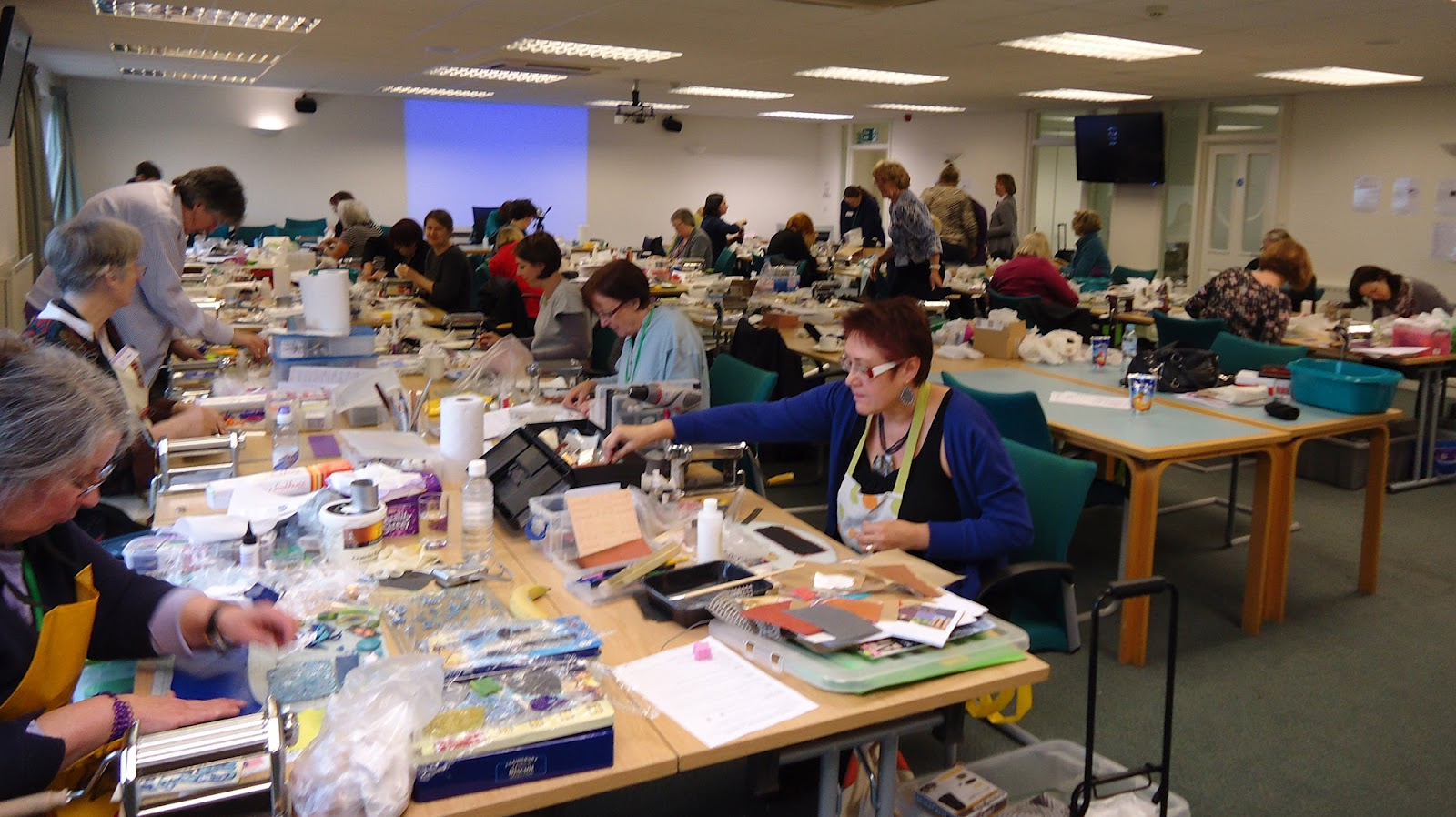
Fourth – This was a new format for a retreat. We met in one of the member’s homes – in a family room filled with tables and chairs. The class size was kept small so that we could really dive into learning both how to mix colors and how to use the Watercolor technique. The format was a smashing success!

Posted in Inspirations | Leave a comment

Worldwide Pasta Machine Survey

Last week Sage Bray, the editor of The Polymer Arts magazine, and I had a guest post on Polymer Clay Daily about measuring thicknesses on pasta machines. We asked the polymer community to follow measuring instructions and fill out a short survey.  We’ve heard from artists all over the world and so far we’ve collected more than 60 responses, not including my 12.

I have over a dozen pasta machines picked up over the years at garage sales and thrift stores. Most of them are similar to the Atlas 150 but two of them are very different. The large white one on the left is a Bialetti, an electric machine with plastic rollers that are slightly textured. The mini one on the right is an old Ampia with the noodle maker permanently attached. I’ve measured them all with both the metric stacking system and the playing card system and found a huge variation. It was an eye opener!

Why does it matter so much to me personally that we come up with a way to consistently and accurately refer to the thickness of pasta machine settings?

In my Watercolor Technique Tutorial I show how to create sheets with the appearance of a watercolor wash. The basic version of the technique is to lay a thin sheet of color on a thick sheet of white and run them through at the thinnest setting on the pasta machine.

I tested three different machines by following the basic Watercolor instructions – thinnest color over thickest white.  I used a 3/4″ square cutter to cut out the same size squares for each sample. The clay run through on the Atlas 150 did not wash – the white does not show through the color. The clay run through the Pasta Queen washed a little bit and the Ampia washed beautifully.

The differences in the amount of color washing are entirely the result of variations in the thick and thin settings.

There are now so many different pasta machines, and the range of settings is so large, that I can no longer use the basic instructions for the Watercolor technique. I need a way to insure that all the students in my classes will get the same results regardless of what pasta machine they use. I need a standard for measuring thickness.

If you’ve already sent in the survey, thank you! If you haven’t, there’s still time. Just go to PCD, measure your pasta machines and fill out the survey. If you do it by Saturday, March 31st at midnight my time, Pacific Standard (PST), you will be entered to win one of the prizes.

We will be publishing a summary of the results on PCD next week. The more data we get from around the world the better! Let’s do it.

Posted in Inspirations | 3 Comments

Rothko’s Red

Portland Center Stage just finished a run of the play “RED” about Mark Rothko. Originally staged in London, the play opened on Broadway two years ago and won the 2010 Tony for Best Play.

This two-person play by John Logan is set in Rothko’s studio in the late 1950′s.  He is working on paintings for the opening of New York’s elite Four Seasons restaurant. His new and much younger assistant, Ken, bears the brunt of his insecurities for taking on this prestigious, and lucrative, commercial commission. In their give and take the audience is treated to a thought-provoking lesson in mid-century art history and a glimpse into the heart and soul of Rothko’s passion for color.

I won’t do a review here – there are many good ones online -  but three quotes about color stuck in my head. The quotes come from separate sections of the play but together they illuminate the themes.

ROTHKO: There is only one thing I fear in life, my friend… One day the black will swallow the red.”

ROTHKO: Because black is the opposite of red. Not on the spectrum, but in reality.

KEN: In reality we both know black’s a tool, just like ochre or magenta. It has no affect. Seeing it as malevolent is a weird sort of chromatic anthropomorphizing”

Daniel Benzali played Rothko at the peak of his career yet concerned about his legacy. Patrick Alparone played Ken as the student turned teacher. I will need to read the screenplay to remember all the choice lines of dialogue. As an artist, a colorist, and a fan of abstract expressionism, it struck chords on many levels. I could go on and on about what I liked (and in some cases – disliked) but let’s just say I was thrilled to be able to see it.

Coming up: A visit to the Portland Museum’s Retrospective of Rothko’s work from the 1920′s through the 1960′s.

Posted in Inspirations | Leave a comment

Zooming In

Often  zooming in on an image can inspire new design and color combination ideas. Today I’m zooming in on chairs.

These are three very different details from chairs made by artists for the Chair Affair fundraiser – the annual auction for the Portland Community Warehouse.

Many Portland artists contribute pieces to the auction. Some make the chairs from scratch, some use recycled chairs. My friend and neighbor, pastel artist Greg Danielson started out with an old chair and the idea of making the legs of a chair be something else. Since many historic chair designs have legs inspired by animals he thought he would do a modernized version.

His first choice of animal was a giraffe, but the proportions caused a problem. How tall would the back need to be to mimic the long neck of the giraffe? His second choice was dogs. Multiple animals seemed more appropriate. While looking at photographs of African animals he saw an image of two zebras who seemed to be embracing neck to neck. Danielson decided that would be perfect.

He started out wanting the zebras to be 3D with the heads curving around to the front but that ended up tipping the chair over. So he went with a 2D design.  He calls his final version a “wingback” chair and says he was painting stripes for a week.

The auction raises money to provide basic furnishings to over 5000 people in need every year.  You can see the full size chairs and other auction items in the gallery for the 2012 Portland Chair Affair.
Portland Community Warehouse 2012 Tables, Chairs and Artists

Posted in Inspirations | Leave a comment